


Press Information
MHI Marine Machinery & Equipment and Mitsubishi Shipbuilding Obtain Approval in Principle (AiP) for the Basic Design of a Methane Oxidation Catalyst System for Marine LNG-Fueled Engines from Classification Society ClassNK

SHARE


・ Approval will accelerate the development and commercialization of the system, contributing to reducing GHG emissions from ships, which is increasingly necessary on a global scale
・ Initial performance measurements during verification testing on an actual ship confirmed a methane oxidation rate of more than 90% for the exhaust gas treatment system alone
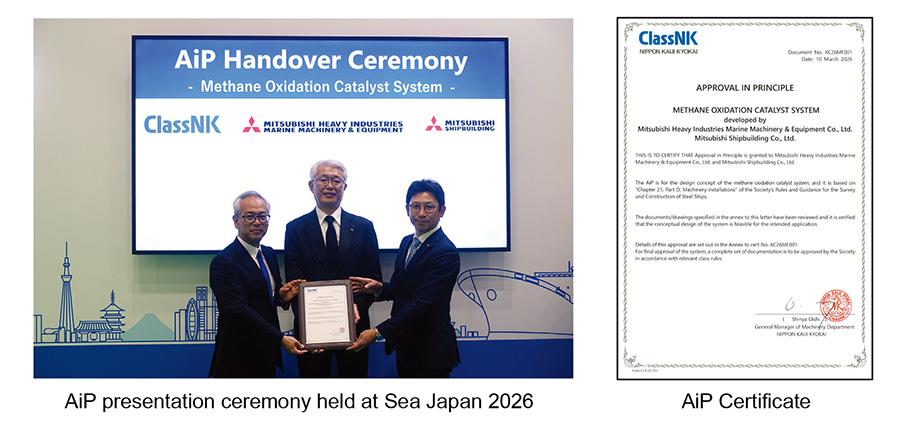
Tokyo, April 22, 2026 - Mitsubishi Heavy Industries Marine Machinery & Equipment Co., Ltd. (MHI-MME) and Mitsubishi Shipbuilding Co., Ltd., both part of the Mitsubishi Heavy Industries (MHI) Group, have obtained Approval in Principle (AiP)(Note1) from Nippon Kaiji Kyokai (ClassNK) for the basic design of a methane oxidation catalyst system for marine LNG (liquefied natural gas)-fueled engines(Note2), jointly developed with Daihatsu Infinearth Mfg. Co., Ltd. A presentation ceremony was held today at Sea Japan 2026, an international maritime exhibition being held at Tokyo Big Sight in Koto-ku, Tokyo.
The methane oxidation catalyst system subject to the AiP oxidizes methane slip (unburned methane) contained in the exhaust gas of marine engines. Methane has a high global warming potential among greenhouse gases (GHGs),(Note3) and therefore the ability to suppress its emissions is a significant advantage of this system. The system was developed with MHI-MME's catalyst design and manufacturing technology at its core, combined with Mitsubishi Shipbuilding's shipboard installation technology, and Daihatsu Infinearth's engine optimization technology.
Verification testing of the catalyst system is currently being conducted in cooperation with Nippon Yusen Kabushiki Kaisha (NYK Line), with a full-scale demonstrator mounted on the KEYS Azalea, an LNG bunkering vessel(Note4) owned and operated by KEYS Bunkering West Japan Ltd. (KEYS). Initial measurements during the verification testing confirmed the expected performance of the exhaust gas treatment equipment, achieving a methane oxidation rate of more than 90% for the system alone.
Following the acquisition of AiP and the confirmation of the expected performance through verification on an actual ship (initial measurements), the partner companies plan to further accelerate development toward commercialization of the system.
MHI Group is making strategic efforts to strengthen its energy transition business. As part of this strategy, MHI-MME and Mitsubishi Shipbuilding will continue their efforts to reduce GHG emissions from marine vessels amid the growing global urgency for decarbonization, thereby contributing to the improvement of the environmental performance of ships on a global scale.
- 1Approval in Principle (AiP) indicates that a certification body has reviewed the basic design of the subject equipment and confirmed that it meets technical requirements and relevant safety standards.
- 2Methane oxidation is a chemical reaction in which methane (CH4) is converted into carbon dioxide (CO2) and water (H2O) through reaction with oxygen.
- 3Greenhouse gases (GHGs) include carbon dioxide (CO2), methane (CH4), and nitrous oxide (N2O). The catalyst system for this demonstration test only targets methane slip.
- 4LNG bunkering vessels are small ships that supply LNG fuel to LNG-fueled vessels.

About MHI Group
Mitsubishi Heavy Industries (MHI) Group is one of the world’s leading industrial groups, spanning energy, smart infrastructure, industrial machinery, aerospace and defense. MHI Group combines cutting-edge technology with deep experience to deliver innovative, integrated solutions that help to realize a carbon neutral world, improve the quality of life and ensure a safer world. For more information, please visit www.mhi.com or follow our insights and stories on spectra.mhi.com.