

CO₂ Compressors Contributing to Realization of Carbon Neutral Society
Mitsubishi Heavy Industries Technical Review Vol.62 No.3 (September 2025)
Engineering and Design Division
A technology that can capture, transport, utilize and store carbon dioxide (CO₂), called CCUS*1, is garnering attention as a means of achieving a carbon-neutral society. Since each CCUS process involves compressing CO₂, a compressor that is very efficient and highly reliable is indispensable. However, CO₂ compressors for CCUS have been dogged by various technological issues because of the properties of the working gas and the characteristics of CCUS plants.
In addition to such technological challenges, this report presents the features of our highly reliable compressors for CCUS.
- 1Carbon dioxide Capture, Utilization and Storage
1. Compressors in demand in CCUS value chain
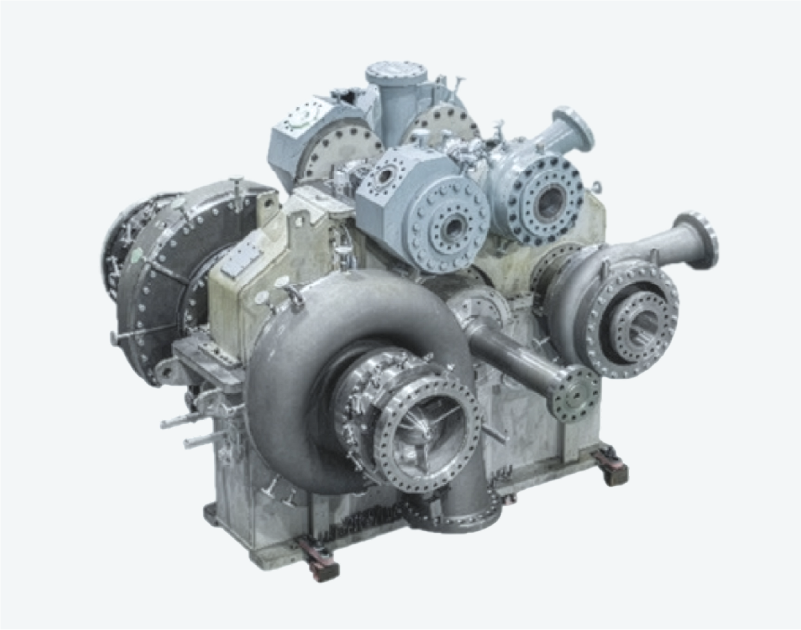
Mitsubishi Heavy Industries Compressor Corporation has engaged in designing, manufacturing and selling large compressors in the fields of oil and gas, petrochemistry and energy for many years. Our compressors also play a key role in the CCUS value chain. As shown in Figure 1, these products are of two types: the single-shaft and multi-stage compressor, and the integrally geared compressor. The former has a single shaft to which multiple impellers are attached, and is called Mitsubishi Advanced Compressor (MAC). The latter, on the other hand, is characterized by the multi-shaft and multi-stage structure in which multiple pinion shafts are driven through the gear in the casing (i.e., geared). This is referred to as Mitsubishi Advanced Compressor Geared (MAC-G).
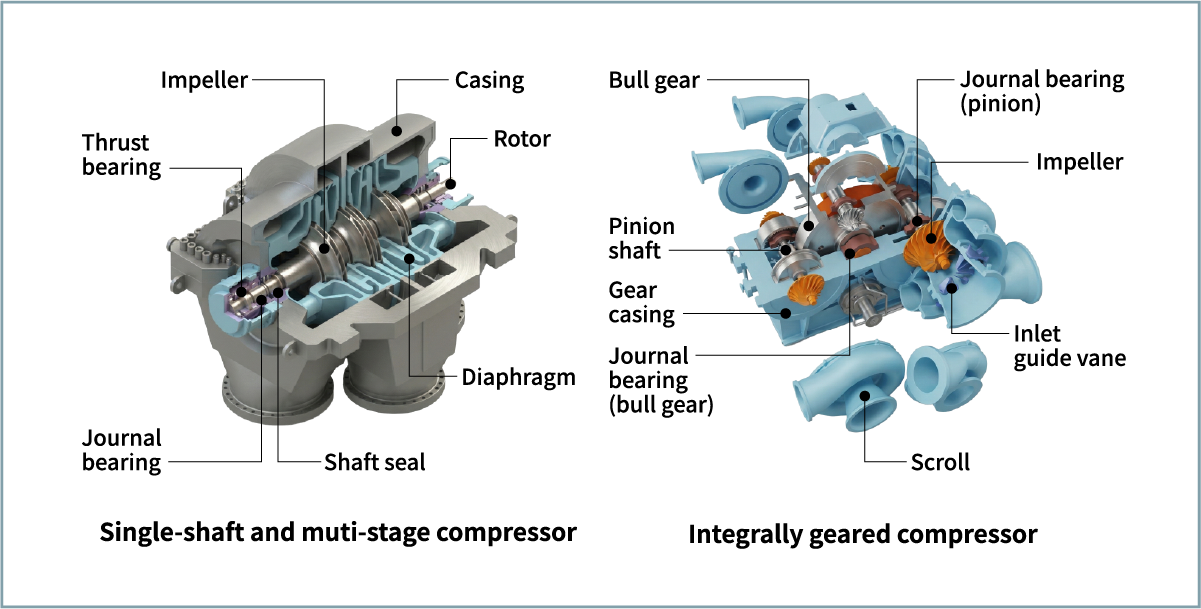
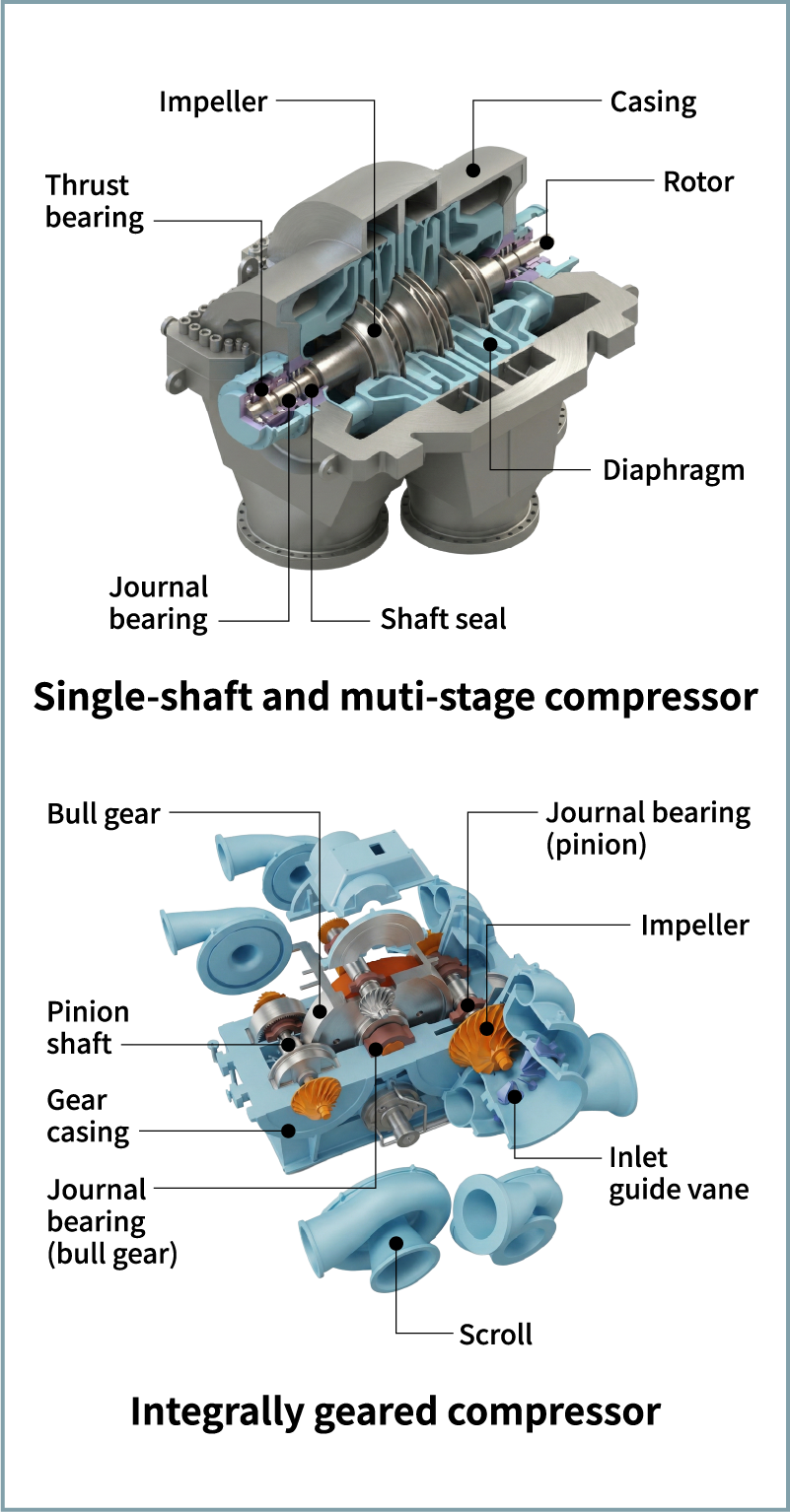
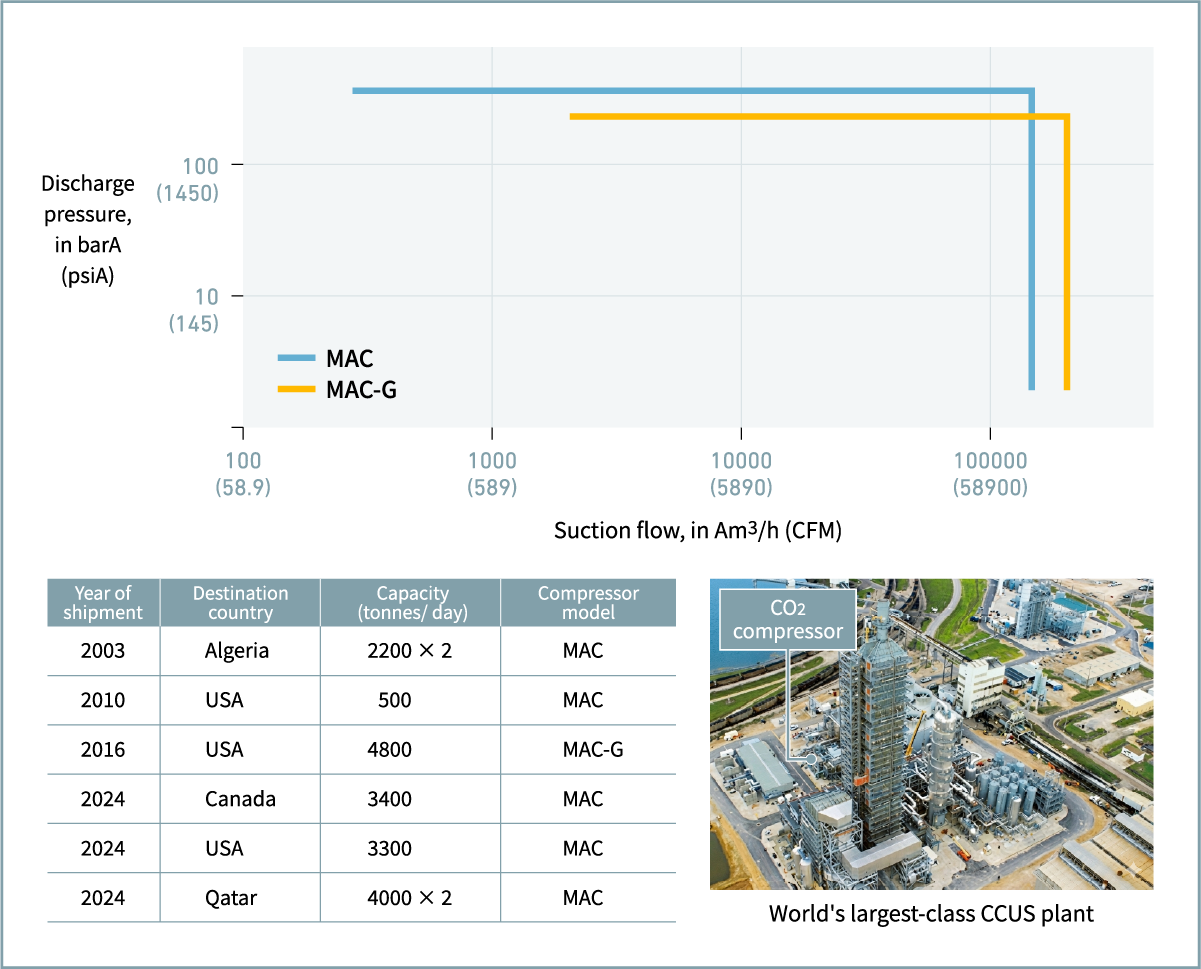
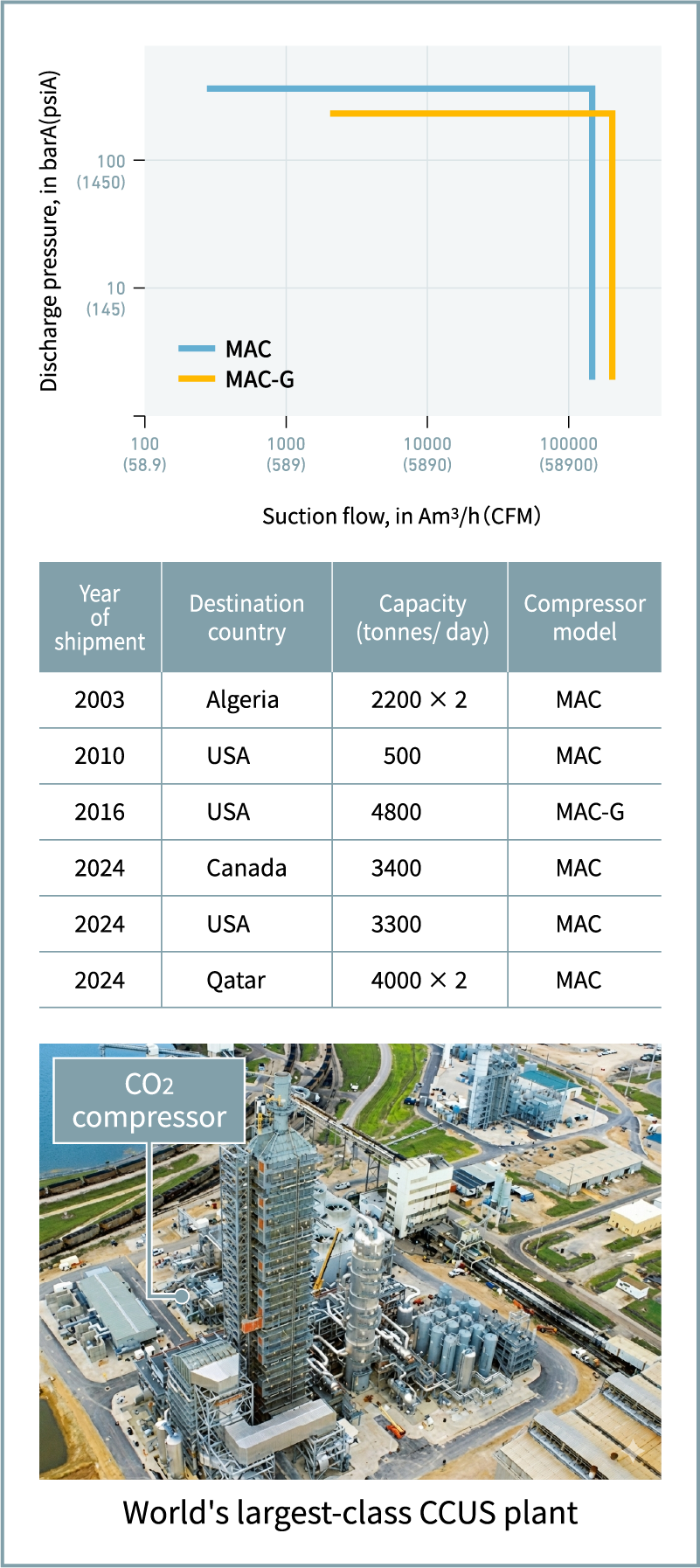
Figure 2 shows the application ranges of our compressors for CCUS and the major delivery records. Since the 1990s, we have provided over 100 CO₂ compressors to fertilizer plants and CCUS plants. Especially when it comes to CCUS application, we have supplied the world's largest-class compressors of both MAC and MAC-G.
MAC and MAC-G have different features in terms of the facility investment cost, operating cost, noise, number of shaft seals, footprint size and maintainability. This enables us to offer best-suited compressor systems to customers according to their diverse needs and operating environments.
2. Features of our compressors for CCUS
The wide-ranging technological issues in CO₂ compressors for CCUS stem from the properties of the working gas and the characteristics of CCUS plants. The specifics are described below.
1. Performance prediction
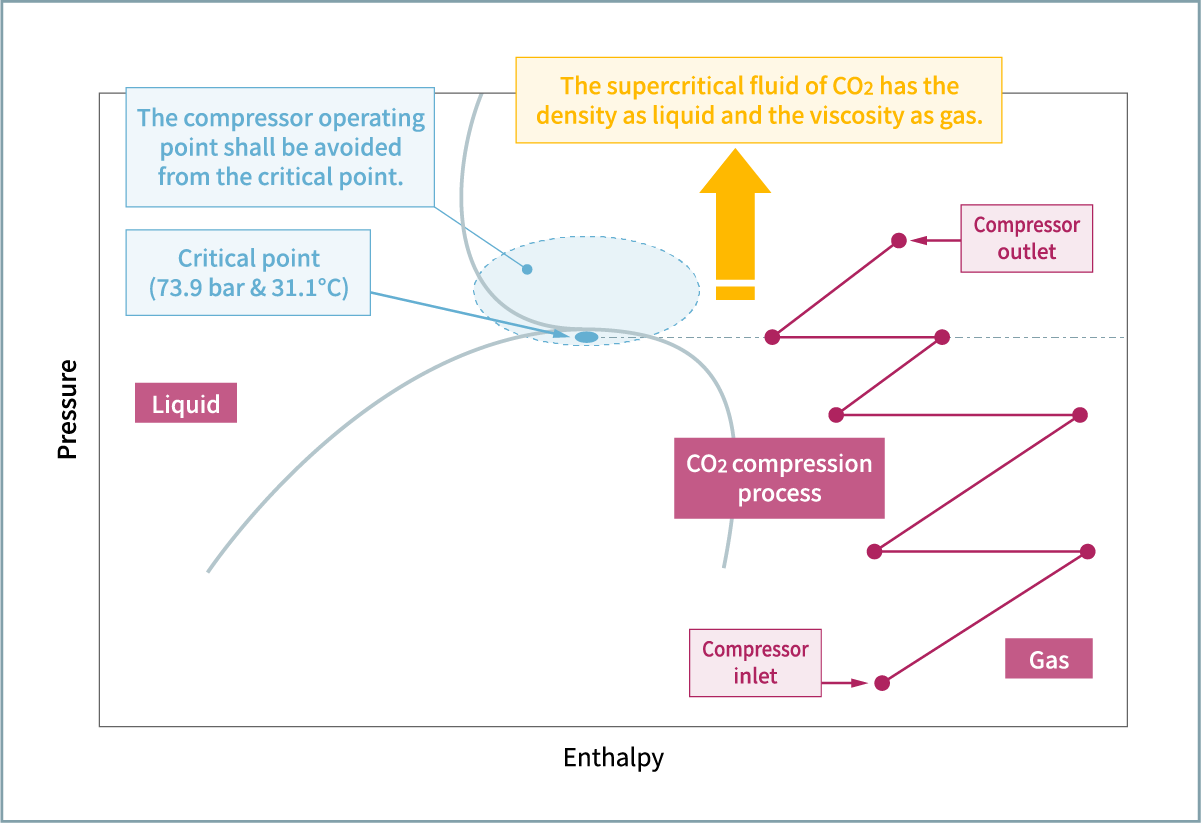
Figure 3 shows the pressure-enthalpy diagram for CO₂. As the pressure and temperature increase, CO₂ reaches a critical point where it can exist as either a liquid or a gas. Exceeding this point, CO₂ becomes a singular supercritical fluid with the density as liquid and the viscosity as gas. As the gas properties rapidly change near the critical point, it becomes difficult to accurately predict the performance. Based on our abundant experience with CO₂ compressors, we have established a performance prediction technology in which the properties of gaseous CO₂ are taken into consideration.
2. Rotor stability
As CO₂ compressors handle high-density gas, the generated excitation force of the fluid is large. Therefore, it is important to design a highly stable rotor by applying high rotor rigidity and an efficient damping system.
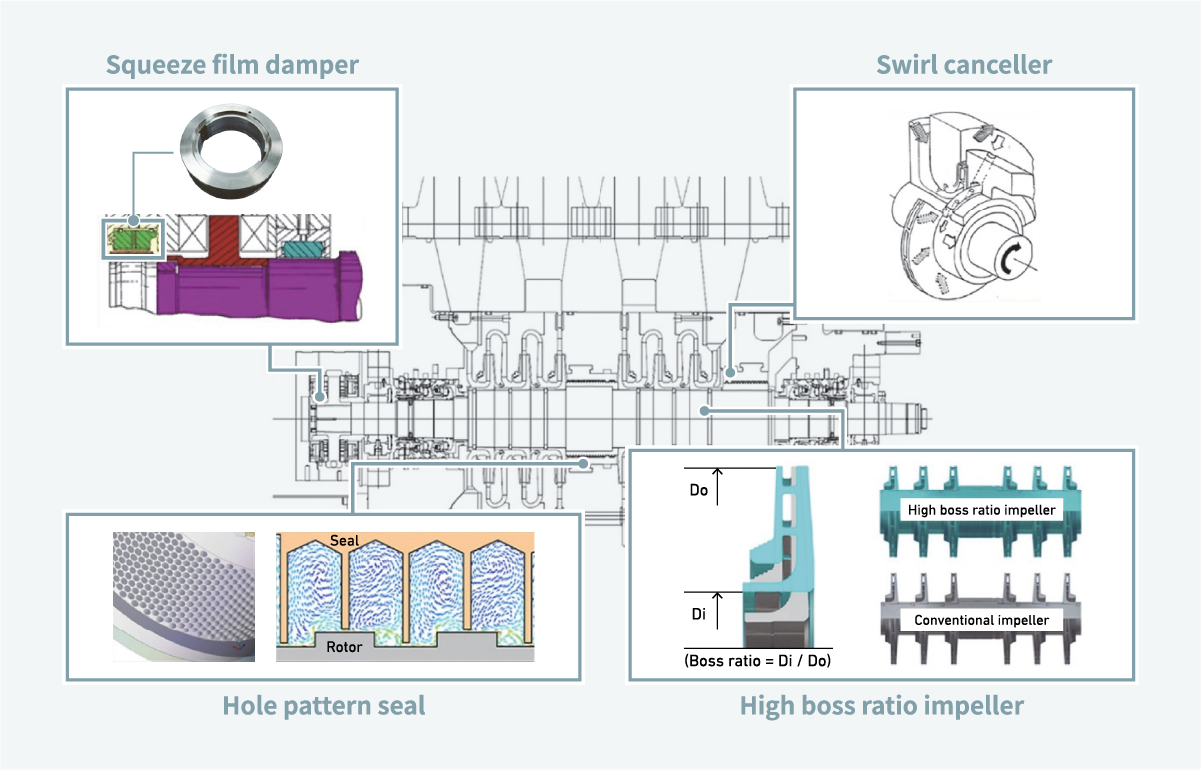
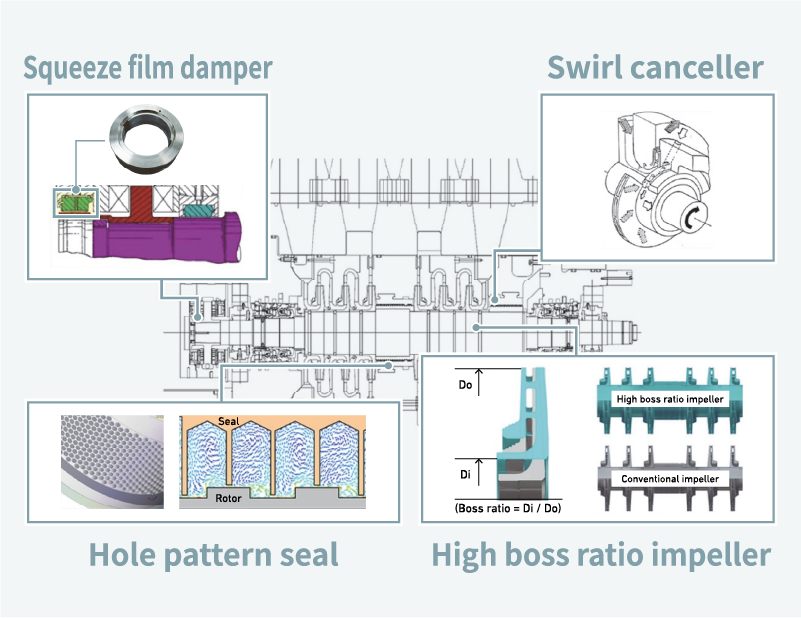
Figure 4 shows our technologies for high rotor rigidity and highly efficient damping. The high boss ratio impeller has been adopted as a means of achieving higher rigidity. In this impeller design, the shaft diameter is increased to improve the rotor rigidity. The boss ratio has been optimized to maintain high efficiency in addition to improved rotor stability.
Employed for highly efficient damping are the squeeze film damper, hole pattern seal, and swirl canceller. The application of these technologies can not only reduce the gas excitation force but also produce a damping effect on the rotor.
3. Material corrosion
CO₂ promptly dissolves in water to form a weakly acidic solution, which causes metal corrosion. Therefore, the materials for use should be corrosion-resistant. We have established a technology for selecting materials such as stainless steel and corrosion-resistant plated materials, which are suitable for use in highly corrosive environments.
4. Facility construction cost
Conventionally, CCUS was mainly applied to enhanced oil recovery (EOR) and gas processing plants. Against a backdrop of recent movement toward decarbonization, however, many countries across the world have started to plan the use of CCUS for CO₂ storage only, rather than EOR. Such CCUS projects require minimizing the costs of facility construction and maintenance. Reduction in the labor cost for facility construction, in particular, is an issue among the developed countries where the introduction of CCUS is in progress.
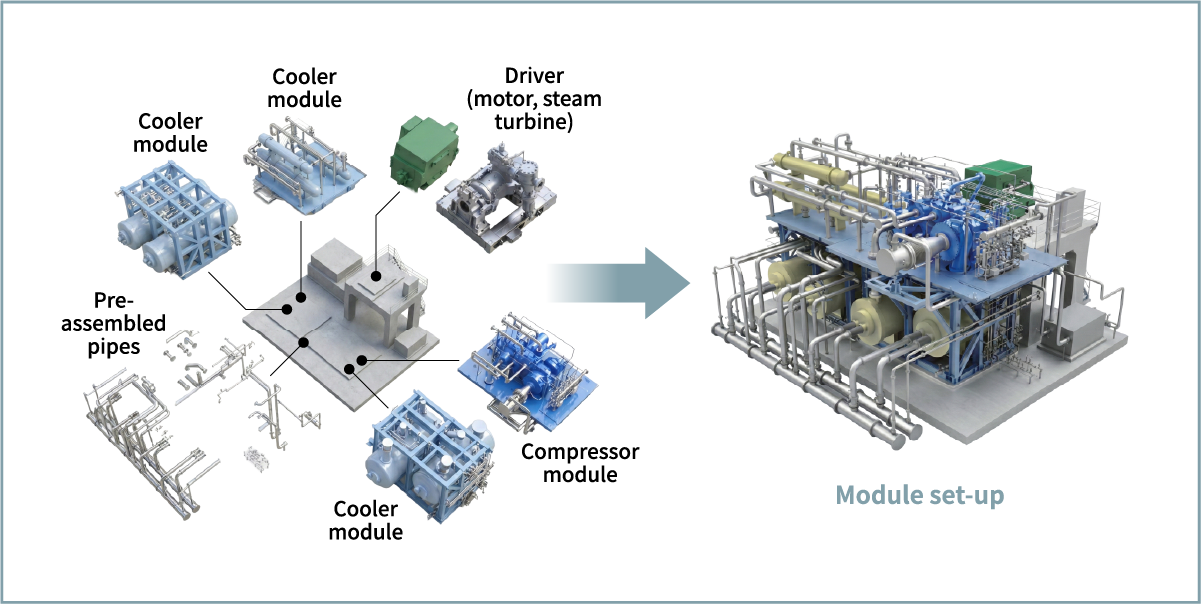
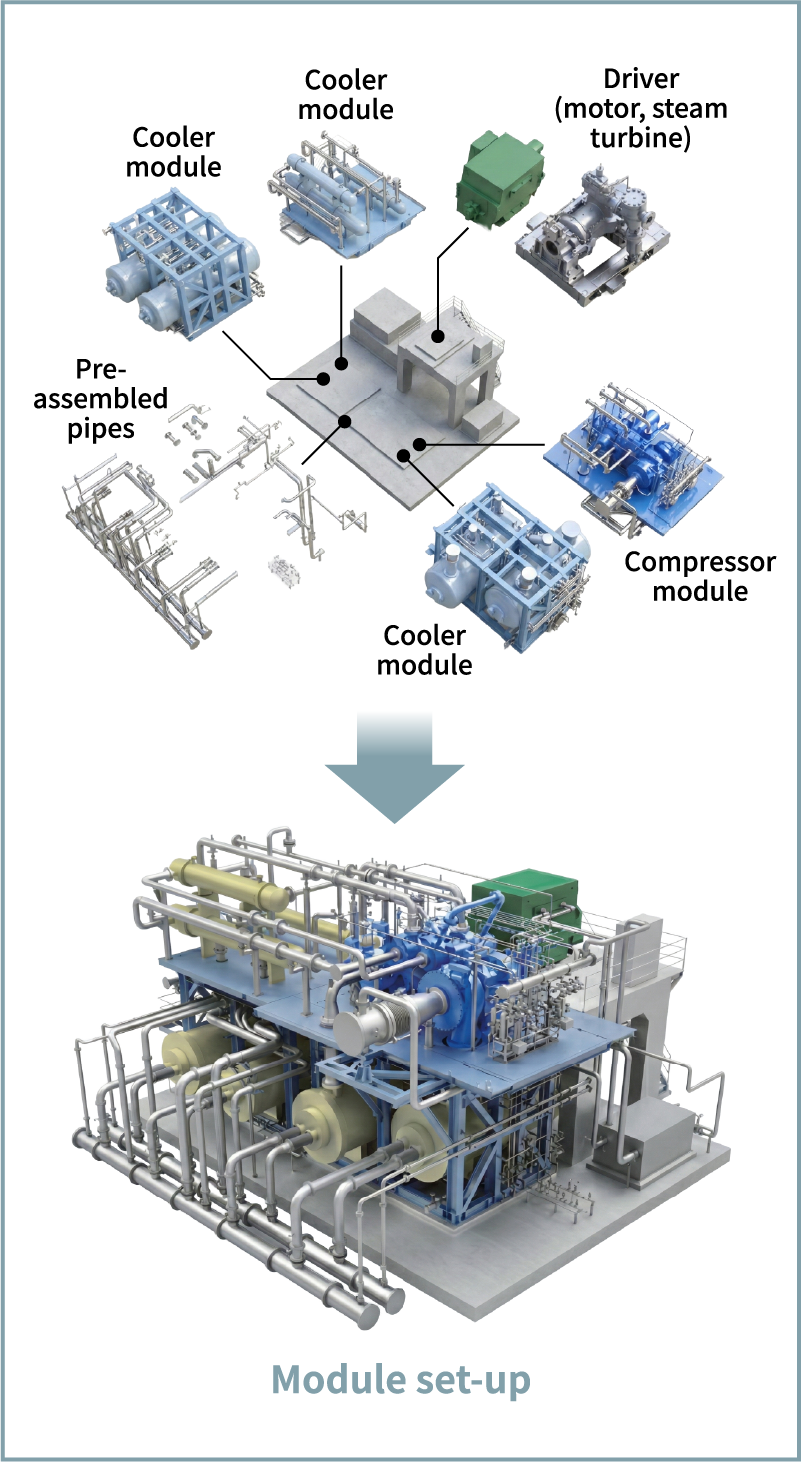
To shorten the period of on-site work, we have made the integrally geared compressor package available (Figure 5). It consists of four modules: one containing the compressor, sealing system and instrumentation, and the remaining three for gas cooling. With this package, the number of components to be transported to the site is minimized. Piping and instrumentation can also be installed after the modules are assembled. It therefore becomes possible to considerably reduce the number of days necessary for on-site work. Assembling the pipes that have been pre-manufactured at the factory can eliminate the need for on-site welding.
Moreover, the integrally geared compressor package has been made compact in its entirety. With a 20% reduction in the footprint from the previous unit, the structure can be easily installed even in a limited space.
3. Future prospect
Based on our abundant experience with CO₂ compressors and delivery record, our compressors for CCUS are available in extensive ranges, and exhibit superiority in reliability, rotor stability, aerodynamic performance, and maintainability. This enables us to provide a compressor system that is best-suited for a customer's CCUS project. As a member company of Mitsubishi Heavy Industries Group, we create synergies with other products such as CO₂ capture equipment to contribute to achieving carbon neutrality.