

Diesel Generator vs Petrol Generator: A Complete Comparison Guide

The Architecture of Reliability
In the industrial power sector, the comparative analysis of a Diesel Generator vs Petrol Generator is frequently reduced to a single, superficial metric, which is the price of fuel at the pump. This is a fundamental error in judgment. For a site engineer or a facility operator, the selection criteria must not be driven by the cost of the liquid, but by the Physics of Combustion.
The distinction between these two engine architectures is a difference in ‘Operational DNA’ and not just a matter of fuel preference. While the Petrol engine is engineered for speed and intermittent bursts, the Diesel Engine is designed for torque and endurance.
The selection of a power generation asset is, fundamentally, a choice of power architecture. That choice begins not with brand or budget, but with load character. Does the application require driving a resistive load such as LED lighting for a short duration? Or does it demand the initiation of a high-inductive load such as a 5HP submersible pump for continuous operation?
These distinctions define the operational envelope. At MVDE, the focus remains on analysing that envelope, examining the structural, thermal and logistical variables. These parameters determine why certain engines are designated for recreational use, while others are engineered for critical infrastructure.
1. Controlled Combustion and Engine Design
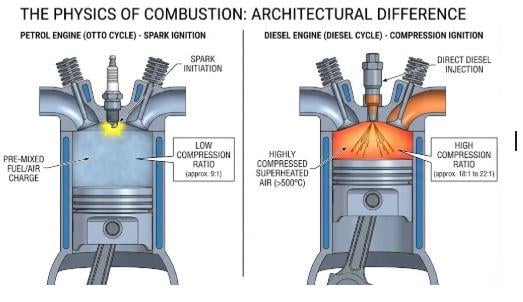
The most significant engineering difference between a Diesel and a Petrol Engine lies in the ignition cycle. This process influences key factors such as thermal efficiency, engine life and load-handling capability.
The High-RPM Architecture of Petrol Engine
A petrol engine operates on the Otto cycle. In this type of setup, fuel and air are mixed before entering the combustion chamber. The mixture is then compressed to a defined limit. In case the compression is too high, the fuel-air mixture can ignite prematurely. This phenomenon is known as knocking and it can damage engine components. This reduces reliability. In order to prevent this, petrol engines operate at lower compression ratios. These ratios are typically between 8:1 and 10:1. The combustion is initiated by a high-voltage spark plug.
This design results in a lighter engine that operates at higher rotational speeds. In this system, fuel burns quickly. Although the engine produces higher RPMs, it delivers lower torque at low speeds compared to compression-ignition systems.
The High-Torque Architecture of Diesel Engine
A diesel engine operates while following the Diesel Cycle. It draws in pure air and compresses it until the temperature naturally rises beyond the auto-ignition point. This is usually over 500°C. Only at this stage, the fuel is introduced. As the fuel is only injected after the compression stroke, it eliminates the risk of pre-ignition. Thus, the diesel engines are able to achieve impressive compression ratios, typically ranging from 16:1 to 22:1.
High compression correlates directly with high thermal efficiency. A diesel engine is able to extract greater mechanical work from every unit of fuel mass than its petrol counterpart. Whereas, for the same volumetric fuel capacity, a diesel unit may deliver up to 30-40% longer operational runtime.
2. Power Quality: The Frequency Stability Factor
Diesel and petrol generators are often compared on torque. Torque measures rotational force. It tells you how much mechanical work the engine can deliver, however an equally important factor is power quality.
Power quality refers to the stability and consistency of the electricity produced. It reflects how clean the output waveform is. It indicates how well voltage and frequency remain within acceptable limits. For sensitive equipment, stable and consistent power is crucial. Fluctuations can affect performance. Prolonged instability can reduce equipment life. Yet this parameter is often overlooked in the debate of Diesel Generator vs Petrol Generator. However, in reality both of these factors are equally important.
Frequency Dip in Petrol Engine
Petrol engines are typically ‘over-square’ featuring short stroke and wide bore. These are designed to generate power at high RPM. When a heavy load, like an air conditioner compressor, turns on, the engine uses speed to recover. However, due to lower rotational mass, the RPM drops instantaneously upon load application. In electrical terms, a drop in RPM equals a drop in Frequency (Hz).
The Result: The standard 50Hz supply may dip to 45Hz. This fluctuation causes lighting flicker. It can lead UPS systems to trip, stressing sensitive electronic components.
Stability of Diesel Engine
Diesel engines are ‘stroke-biased’ ( having long stroke and narrow bore), generating massive Low-End Torque. Also, the industrial diesel engines are equipped with heavier flywheels. Thus, when a heavy load step occurs, the diesel engine does not require high RPM to recover from such a situation. It relies on the momentum of the flywheel and the high-torque combustion to push through the resistance. The RPM remains constant while the Frequency remains locked at 50Hz. To protect the sensitive equipment from the voltage sag, this ‘Stiff Power’ is essential.
3. Industrial Durability in a Compact Frame
For decades, a market gap existed for small-capacity power engines ( ranging below 5 kVA). Due to the light weight constraint, this segment was largely dominated by petrol engines. Diesel engines were viewed as too heavy or expensive for small-scale applications. However, the modern mini diesel engine generator has changed this scenario. Advanced aluminum alloys and precision injection systems are driving innovation in this sector. These breakthroughs have allowed for the immense durability of a 100 kVA industrial block to be successfully scaled down. Now, that same power is available in a truly portable size.
The Operational Shift
Consider a commercial application in a Tier-2 city facing daily power cuts.
Limitations of a Petrol Engine: A portable petrol gen-set is designed for intermittent duty or a standby usage. Continuous operation where it runs for 6+ hours daily, may lead to rapid wearing of its components. Thus, such an engine will need a cylinder repair within 2,000 hours of operation.
The Diesel Solution: A mini diesel engine generator incorporates cast-iron liners and heavy-duty bearings, that are often used in agricultural tractors. It is engineered for continuous duty. While the initial capital outlay is higher, the service life often exceeds 15,000 operational hours, effectively transforming a backup solution into a prime power asset.
4. Site Logistics: Chemical Safety & Storage
In the Indian industrial context, ‘Logistics’ acts as a critical operational constraint. For site management, fuel handling protocols are paramount.
The Volatility Risk
Petrol has a flash point of approximately -43°C. This means it can form ignitable vapours even at very low temperatures. In warm climates, particularly on construction sites where ambient temperatures may exceed 40°C, the formation of such vapours increases. This elevates handling and storage risk. Ignition sources do not need to be dramatic. A static discharge or contact with a hot surface can be sufficient under certain conditions.
The Stability of Diesel
Diesel has a significantly higher flash point as compared to Petrol. It is typically above 52°C. At normal ambient temperatures, it does not form ignitable vapours. This difference influences site-level safety considerations.
Higher chemical stability simplifies bulk storage protocols. This is a reason why heavy machinery such as excavators, trucks and tractors prefer a diesel engine. In addition to this, standardising generators on the same fuel reduces supply chain complexity while eliminating the need to manage multiple fuel options on the same site.
| Feature | Petrol Generator | Diesel Generator (MVDE Standard) |
|---|---|---|
| Ignition Architecture | Spark (External Ignition) | Compression (Auto-Ignition) |
| Compression Ratio | Low (9:1) | High (18:1) |
| Torque Profile | Low Torque / High RPM | High Torque / Low RPM |
| Thermal Efficiency | ~25% | ~40% |
| Fuel Safety Profile | High Volatility (Risk) | Low Volatility (Stable) |
| Service Life | Short (~2,000 Hours) | Long (~15,000+ Hours) |
| Ideal Application | Residential Backup, Camping | Industrial, Agriculture, Construction |
Designing for Energy Continuity
The MVDE philosophy extends beyond component durability; it encompasses Energy Independence. Field operations cannot rely on ideal conditions, a stable grid or a fuel that is unsafe for bulk storage. When an operator is selecting a Diesel Engine, he is opting for a system that is thermally efficient and safer. It ensures that the operation, whether it is a harvest or a construction deadline, maintains continuity regardless of external power fluctuations. Reliability is a function of design. And design, at its core, follows thermodynamic discipline.
SHARE


