

Marine Diesel Engines: The Complete Industry Guide

A marine engine does not operate in isolation. It is the central node of a complex hydrodynamic and thermodynamic system. While the internal metallurgy of the engine is critical, 60% of marine propulsion failures are not caused by the engine block itself, but by poor integration with the vessel’s auxiliary systems: air, fuel, exhaust and the propeller.
Selecting the engine is just the beginning. The real engineering task is ensuring efficient air intake, cooling and torque transfer.
This guide moves beyond the basics of corrosion and load profiles to analyze the Systems Integration required for reliable marine diesel engines.
1. The Mathematics of Sizing: Avoiding ‘Over-Propping’
The most common cause of premature marine engine failure is not a manufacturing defect; it is a mismatch between the engine’s power curve and the propeller’s demand curve.
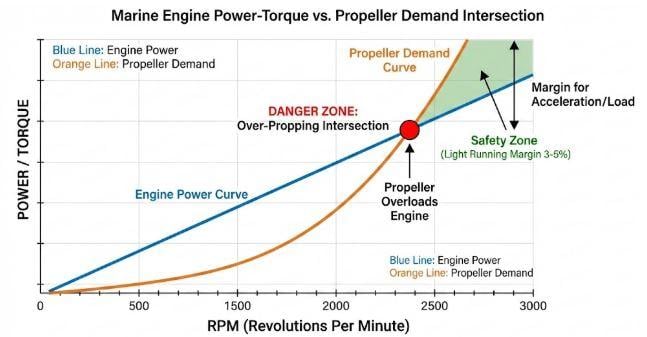
Fig: Marine ENgine Power-Torque vs. propeller Demand Intersection
The Propeller Curve Reality Unlike a truck transmission which has gears to relieve load, a fixed-pitch propeller creates a load that rises exponentially with RPM (The Cubic Law).
The Over-Propping Trap: If a vessel is fitted with a propeller that is too large (high pitch/diameter) for the hull’s weight, the engine will hit its maximum torque limit before it reaches its rated RPM.
The Consequence: This creates a condition known as ‘Locked Rotor’ or ‘Lug’. When a large amount of fuel is injected for full power, the engine pistons are unable to keep up. Their slow movement prevents the proper burning of all the fuel.The result is the emission of black smoke, which is the unburnt fuel. Exhaust Gas Temperatures (EGT) rise significantly. This is detrimental to the engine and causes rapid 'washing' of the cylinder liners, leading to wear.
| Operational Indicator | Correctly Propped Vessel | Over-Propped Vessel (Heavy Running) |
|---|---|---|
| RPM at Wide Open Throttle (WOT) | Reaches Rated RPM + Light Running Margin (3-5%) | Fails to reach Rated RPM |
| Engine Load Status | Within Thermal Limits | ‘Locked Rotor’ / Lug Condition |
| Exhaust Gas Temperature (EGT) | Normal | Spikes (Due to incomplete combustion) |
| Fuel Efficiency | Optimal (Per Propeller Law) | Poor (Energy lost as Heat/Smoke) |
| Long-Term Consequence | Design Service Life | Cylinder Glazing & Thermal Overload |
MVDE Engineering Protocol:
When consulting with marine diesel engines manufacturers, the goal is to size the engine such that it can reach its rated RPM + 5% under full load. This ‘Light Running Margin’ ensures the engine never operates in a lug condition, even when the hull gets heavy with bio-fouling.
2. Installation Physics: The Invisible Constraints
An engine is essentially an air pump. It needs to inhale cool air and exhale hot gas without resistance. In the tight confines of a marine engine room, this physics is often neglected.
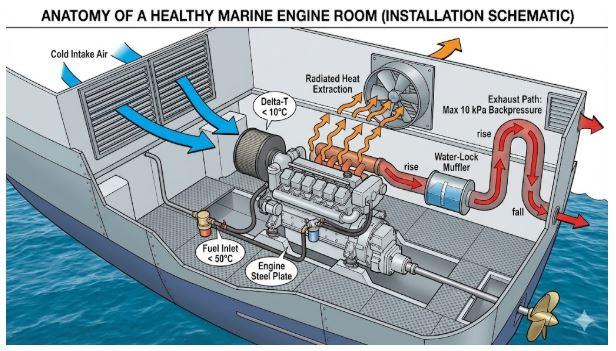
Figure: Anatomy of a Healthy Marine Engine Room
Air Intake and Delta-T
A large marine diesel engine needs huge amounts of air for combustion. If the engine room ventilation isn't big enough, the engine pulls a vacuum, essentially choking itself of air.
The Temperature Factor:
Furthermore, radiated heat can raise the engine room temperature. If the intake air exceeds 45°C (High Delta-T), the air density drops. The engine loses power (derating) and thermal efficiency plummets. Correct sizing of passive and active ventilation is non-negotiable.
Exhaust Backpressure Marine exhaust systems often involve water-lock mufflers and long, winding rubber hoses to exit the transom.
The Risk:
Every curve in the exhaust system resists the flow while creating the backpressure. When this backpressure gets too high (usually over 10-15 kPa), the engine can't fully push out the burned gas during the exhaust stroke. This hot, leftover gas contaminates the incoming fresh air, causing internal temperatures to jump.
Compare your vessel's performance against these operational benchmarks to identify if your engine is suffering from propeller overload.
| System Parameter | Maximum Allowable Limit | Engineering Rationale |
|---|---|---|
| Exhaust Backpressure | 10 kPa (Turbo) / 7.5 kPa (NA) | Exceeding the limit traps hot gas, causing valve burnout. |
| Intake Air Temp (Delta-T) | Ambient + 10°C | Power decreases approx. 3% for every 10°C rise (ISO 3046). |
| Fuel Inlet Temperature | Max 50°C | Viscosity drops below 2.0 cSt, risking pump seizure. |
| Installation Angle | 15° Static (Flywheel Down) | Prevents oil starvation in the sump. |
3. Fuel System Hygiene: The Hygroscopic Threat
Water is the enemy of high-pressure common rail (HPCR) or mechanical injection systems. In a marine environment, fuel tanks are prone to condensation due to temperature shifts between day and night.
The Emulsion Problem
Diesel is hygroscopic; it absorbs moisture. When water enters the high-pressure fuel pump:
Viscosity Loss: Water has no lubricating properties. It causes immediate scoring of the injector needles and pump plungers.
Explosive Expansion: When water hits the superheated combustion chamber, it flashes to steam, blowing the tips off injectors.
The Solution:
Leading marine diesel engines suppliers mandates a multi-stage filtration strategy. This must include a primary "Water Separator" (typically 10-30 micron) installed before the engine’s fine fuel filter to strip emulsified water from the fuel supply.
4. Regulatory Compliance: The IMO Tiers
The selection of a marine engine is no longer just about horsepower; it is about legality.
IMO Tier I, II and III:
The International Maritime Organization (IMO) sets the regulations for NOx and SOx emissions. The rules depend on where a ship operates. They also depend on when the ship's keel was laid.
Inland Waterways:
Local harbor regulations are often quite strict. They frequently require tighter limits on smoke emissions. They also impose more restrictive noise standards. These demands usually exceed those set for the open ocean.
At MVDE, we power solutions, prioritizing reliable engine operation, especially in remote environments. Our design approach balances regulatory compliance with intrinsic simplicity. We avoid complex after-treatment systems where possible to preserve essential reliability.
5. Selecting the Right Partner
The distinction between a generic ‘engine seller’ and a dedicated marine diesel engines manufacturer lies in the support ecosystem.
The Parts Availability Index
A marine engine may operate in remote archipelagos or offshore zones. A supplier must be evaluated not on the price of the engine, but on the availability of critical spares such as impellers, filters, gaskets etc. in the vessel’s region of operation.
The Technical Integration Support
A successful marine application requires a solid foundation. MVDE provides robust, high-performance base diesel engines and precise engine-level technical data. By offering accurate power curves, structural dimensions, and durable engine blocks, we ensure that OEMs and marine integrators have the exact mechanical platform they need to successfully marinize the engine and build out the vessel's complete propulsion system.
Conclusion: System-Level Reliability
A marine vessel is a machine of survival. Its propulsion system cannot be treated as a collection of loose parts. It must be designed as a cohesive unit where air, fuel, water, and torque interact perfectly. At MVDE, we supply the rugged, dependable base diesel engines that serve as the heart of these systems. Our engines are engineered to deliver consistent torque and thermal stability, providing our OEM partners with the ultimate foundation to marinize and conquer the harsh realities of the open water.
Frequently Asked Questions
Q1: How do I know if my vessel is ‘Over-Propped’?
An easy way to check if your vessel is over propped is to perform a Wide Open Throttle (WOT) test, with a clean hull and a healthy engine. If your engine fails to reach its 'Rated RPM' under these conditions, its propeller pitch is likely too large or over-propped.
Q2: What is the maximum allowable exhaust backpressure?
For a naturally aspirated engine, the maximum recommended backpressure is 7-10 kPa. For a turbocharged engine it's 10-15 kPa. When these limits are exceeded, it can lead to overheating and damage to the turbocharger.
Q3: Why is ‘Engine Room Ventilation’ critical?
To burn fuel efficiently, engines need cool and dense air. If the engine room is extremely hot (above 45°C) or sealed too tightly, the engine may suffocate. This leads to power loss (derating) and increased black smoke.
SHARE


