

Why Water-Cooled Diesel Generators Are the Only Choice for Heavy-Duty Applications

In the world of industrial power generation, ‘heavy-duty’ is a brutal operational reality. It defines a scenario where a generator must run from 12, 18 or 24 hours straight, often under shifting electrical loads. In these conditions, the method of cooling the engine ceases to be a minor technical detail and becomes the single most critical factor determining the unit's lifespan.
The market offers various air-cooled generators that promise high output at a lower initial cost. They are adequate for intermittent residential use. However, for industrial applications such as construction sites and manufacturing plants, relying on air cooling is a calculated risk that often fails.
This guide analyses the thermodynamics of heavy-duty power generation and explains why water-cooled diesel generators are the only scientifically sound choice for continuous operations.
The Physics of Heat
Engines don’t usually fail because something suddenly goes wrong. They fail because of gradual build up of heat. A diesel engine under continuous load generates extreme heat inside the combustion chamber. If this heat is not removed instantly in a uniform manner, the metal components tend to expand. This expansion compromises accuracy and drastically affects the overall precision.

Fig: Thermal Imaging Comparison (Air vs. Water Cooled under Load)
Limitations for Air-Cooled Mechanism
In an air-cooled engine, a fan blows ambient air over external metal fins. This is an inefficient method of heat transfer. Air is a poor conductor compared to liquid. Consequently, air-cooled engines often run hotter and suffer from ‘hot spots’. These are the areas where airflow is blocked or insufficient.
Advantage of Water-Cooled Mechanism
Water-cooled diesel generators circulate liquid directly through the engine block’s internal jacket. This active heat rejection is the only way to maintain stability during continuous, heavy-duty cycles.
Controlled cooling ensures the entire block stays at an even temperature. This prevents localized hot spots from warping the metal and shifting the internal gaps. As a result, pistons run within their designed limits rather than fighting the thermal distortion. This is where Air Cooled Engines struggle over longer operational hours.
The Impact of Thermal Stability on Mechanical Wear
Cooling is not merely about temperature reduction. It is a structural determinant of engine life. The choice of cooling architecture dictates the internal tolerances and the long-term integrity of the engine's components. Here is how thermal stability physically influences durability:
1. Piston-to-Wall Clearance and Compression Efficiency
Stable operating temperatures allow for tighter piston gaps. Since the metal does not expand unpredictably, the fit remains precise without the risk of seizing. This leads to superior compression and a longer service life.
Excessive clearance eventually leads to piston slap, blow-by and erratic wear patterns. These gaps degrade compression and drive up oil consumption, forcing the liners to fail prematurely. Engines that operate within a fixed thermal window avoid these issues. Because the internal dimensions stay stable, the rings seat properly and wear remains uniform. This consistency results in a service life that significantly outlasts air-cooled alternatives.
2. Lubrication Stability and Viscosity Control
Engine longevity depends on the integrity of the oil film between moving surfaces. Air-cooled systems are vulnerable here because they can’t stop the oil from thinning out when the heat climbs. Excessive heat thins the oil until the protective film collapses. Without that barrier, the crankshaft journals rub directly against the bearings, causing the exact metal-on-metal wear that a lubricant is supposed to prevent.
Liquid-cooled designs solve this by using a heat exchanger to tie the oil temperature to the coolant. This keeps the viscosity stable, ensuring the bearings stay protected no matter how hot the air gets on site.
3. Ambient Temperature Derating (ISO 3046)
Standard ratings use 25°C as a baseline. That works on paper, but it’s rarely true in the field. While operating in actual industrial conditions, this standard temperature varies significantly.
Air-cooled units rely entirely on the temperature differential to shed heat. When the air is hot, that differential narrows and cooling efficiency drops off a cliff. The engine is derated just to keep it running. This is addressed by engineering a thermal reserve. By sizing the radiator to handle high-ambient extremes, water-cooled systems decouple performance from the weather and the engine delivers its full rated power.
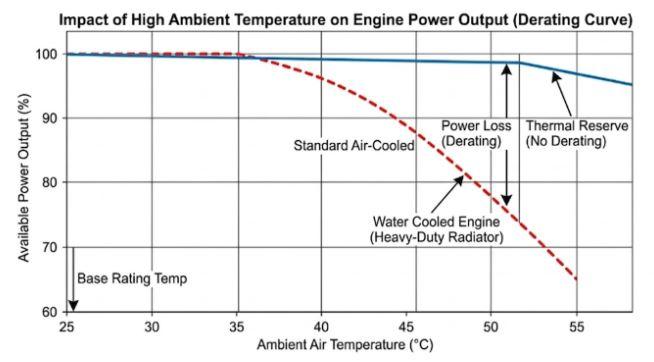
Fig: Ambient Temperature vs. Power Output Graph (Derating Curve)
Comparative Technical Specification
The table below details exactly where the MVDE’s engines depart from standard air-cooled architectures.
| Parameter | Air-Cooled Engine | Water-Cooled Engine |
|---|---|---|
| Cooling Method | Forced Air Convection (Ambient) | Liquid Circulation + Radiator |
| Combustion Technology | Standard Direct Injection | Swirl Chamber (High Efficiency) |
| Thermal Stability | Variable (Dependent on Ambient Air) | Constant (Thermostat Controlled) |
| Piston-to-Wall Clearance | Wide (To accommodate expansion) | Precision / Tight |
| Lubrication Cooling | Sump Radiation Only | Stable Block Temperature |
| ISO 3046 Derating (at 45°C) | High (Significant Power Loss) | Minimal / Negligible |
| Recommended Duty Cycle | Intermittent / Standby | Continuous / Prime Power |
Lifecycle Cost Analysis: CAPEX vs. OPEX
Air-cooled units have lower upfront costs (CAPEX), but their long-term running costs (OPEX) are much higher for continuous operation. The lack of thermal stability in air-cooled systems creates three distinct ongoing costs as follows:
1. Accelerated Lubricant Oxidation:
High sump temperatures accelerate oil oxidation, requiring much shorter drain intervals (often 100 hours) than the standard 250–500 hours seen in stable, water-cooled systems.
2. Reduced Time Between Overhauls (TBO):
Extreme temperature changes and looser mechanical fits cause parts to wear out faster. This means air-cooled engines usually need major repairs sooner than water-cooled ones.
3. The High Cost of Downtime:
In a prime power setting, the price of the generator is rarely the largest number on the balance sheet. The real risk is a thermal shutdown during a peak production window. If an air-cooled unit trips in the summer heat and halts operations, the resulting revenue loss can easily exceed the entire capital cost of the engine. At that point, the ‘cheaper’ cooling option becomes an expensive planning failure.
Pre-Purchase Checklist
Before finalising a purchase for your facility, evaluate the unit against these technical benchmarks.
1. Check the Duty Rating
Is the engine rated for ‘Prime Power’ (unlimited hours) or just ‘Standby’? Air-cooled units are rarely true Prime Power machines.
2. Inspect the Radiator Size
For Indian conditions, look for an ‘over-sized’ radiator capacity to handle peak summer heat. Also ensure that the radiator fins are accessible for cleaning. This is important for sites such as stone crushers where dust is a crucial problem.
Conclusion: Selecting the Correct Architecture
While selecting an engine, whether to go with a water cooled or air cooled engine largely relies on the desired application. For light use such as emergency backup, an air-cooled engine unit is a cost-effective solution. For heavy-duty industrial applications that require continuous running with reliability, a water-cooled engine becomes a better strategic choice.
Every engine in the MVDE portfolio is water-cooled. This architecture is selected specifically to support continuous duty cycles, ensuring stable performance without the derating risks associated with air-cooled alternatives.
For related technical perspectives on diesel engine applications and selection, explore our other blog posts on the MVDE knowledge hub.
Frequently Asked Questions
Q1: Can I use an air-cooled generator for continuous 24-hour use?
Air-cooled engines are usually built for standby running and not for continuous use. Running these engines continuously can lead them to reach the point of thermal saturation. This is where fins can't shed heat as fast as combustion creates it, increasing the risk of piston seizures.
Q2: Does a water-cooled generator require more maintenance?
It’s actually the opposite. Liquid-cooled engines are actually easier to maintain. Due to the controlled temperature, the oil lasts longer and the internal parts stay intact. However, periodical checks of coolant are essential.
Q3: Is there a difference in fuel consumption between the two architectures?
Yes. Because water-cooled engines maintain a precise operating temperature, the combustion cycle is more efficient compared to air-cooled engines.
SHARE


